

CEEA Talks: Sabine Andersone on BAMU and Latvian Animation: ”The time to reconnect and build Baltic partnerships”
Sabine Andersone feels at home at CEEA, although she (and her compatriots) do not feel they are part of Central and Eastern Europe. Their attention is too firmly fixed on the eastern borders and the threat lurking there. But look on the bright side: a shared threat can also foster cooperation. And that is precisely the aim of the Baltic Animation Meet-up (BAMU), according to Andersone, who is not only a producer for Atom Art (BORN IN THE JUNGLE) but also heads the Latvian Animation Association. If there is one country in Europe where animation has found a new lease of life over the past year, it is Latvia. And there was one very clear reason for that…
First, let’s confirm: if we want to talk about Latvian animation, we have two options. Either we don’t talk about FLOW at all (because there’s already been so much talk about it), or we address it already in the very first question.
Sabine Andersone: We can’t ignore FLOW! The film has been a huge success; it raised the profile of Latvian animation and created a wave that our entire industry can ride and benefit from. Animation has been a vivid part of our cinema and visual arts culture for many decades, and suddenly the world saw where we stand. The National Film Centre has used this momentum to secure additional funding for production and PR. A whole series of events put our work in the spotlight, such as the Latvian focus at Cartoon Movie and a retrospective featuring more than 70 titles at MONSTRA – Lisbon Animation Festival. All this paved the way for the Baltic Animation Meet-up (BAMU) at the Riga International Film Festival.
Did this success also change the perception among Latvians? Do your neighbours now assume you have a swimming pool and a Rolls-Royce?
Andersone: The perception has changed tremendously. It was all eyes on animation! People began to take a keen interest, not just in glamorous premieres but even in the success of short films.
At a meeting with representatives from European national film funds, organised by CEEA in March, I sensed great enthusiasm for FLOW from the other Baltic states, even though none of them were co-producers.
Andersone: All Baltic States genuinely celebrated our success. Historically, there has been little Baltic co-production in animation. There have been some collaborations, like Vladimir Leschiov’s short films, but they were rare. People tend to forget that although we’re neighbouring countries, we speak three different languages. That’s why we thought it was high time for something like BAMU. The potential for future collaborations is huge.
Should BAMU be a yearly event or a permanent state of mind?
Andersone: There was already a BAMU event before COVID, a humble attempt to bring Baltic producers together, but back then, many of us were still establishing ourselves. Now, after the FLOW wave, is the time to reconnect and build Baltic partnerships. We need to raise the bar, with long-term ambitions. Last year, BAMU consisted mainly of a few case studies and studio presentations; this year we want to further develop the event.
The first driving force behind BAMU was Latvian.
Andersone: Absolutely, the Latvian Film Centre and the Animation Association reached out to the Riga International Film Festival. The festival has a strong industry section, and we want to secure a place for animation within it. Riga can serve as a bridge between Vilnius and Tallinn.
Is this related to the fact that, from all the Baltic states, Latvia used to have the smallest animation funding budget?
Andersone: The budget remained stable for eight years. But last year, in the aftermath of FLOW, only two items in the Latvian budget received increased funding: national defence and animation! Defence spending is rising across the Baltic states for obvious reasons, but we are very pleased with the extra million that was made available for animation. Gints Zilbalodis has already secured funding for his next feature!
What can you reveal about this year’s BAMU programme?
Andersone: We are finalising the details together with the Riga Film Festival. This year, we will have a focus on France. French producers and the heads of leading studios will present their projects to Baltic producers to explore opportunities for collaboration. In addition to lectures and case studies, particular attention will be given to adapting books for animation.
What is it about the French that makes everyone want to work with them? I see them popping up so often as partners across the CEEA network.
Andersone: It’s no secret that France is an animation powerhouse. We were contacted by a French Cultural Attaché who had funds available to encourage cooperation between France and the Baltics. Next year, we plan to focus on Portugal, building on the positive contacts we made last year with the MONSTRA festival and the Portuguese Producers’ Association. But when it comes to co-production, CEEA countries such as Poland and the Czech Republic feel like the most natural partners to me. We share a common history and have similar aesthetics, cultural values, and budgets, all of which are important for successful collaboration.
How should I understand BAMU’s funding structure?
Andersone: The Riga International Film Festival is integrating BAMU into its industry section Riga IFF Forum, and managing the finances. The festival is recognised as an important event and receives support from the National Film Centre, the Culture Capital Foundation, the Riga City Council, and many others. It felt very natural for the other Baltic film centres to come on board. We’ve presented ourselves as a single unit for many years by sharing one Baltic stand at the MIFA market. Together, we are stronger and gain more visibility.
You are also the Head of the Latvian Animation Association, which recently joined the CEEA network.
Andersone: The small Latvian animation community used to be scattered and disconnected, which we sought to address by establishing the association in 2016. We now have around 30 members, representing studios, producers, artists, and even critics. The success of FLOW has certainly given us an extra boost: we want to make the most of this moment.
What else is needed to strengthen the Latvian animation sector?
Andersone: Education! Training wasn’t quite up to scratch in the past. The Academy of Culture and the Academy of Arts have now launched a joint four-year bachelor’s programme in visual storytelling, with the option to specialise in animation or illustration. We’ve always been good at developing distinctive authorial voices, and this programme will nurture new talent in the coming years that can bridge the gap with earlier generations.
I recently spoke with Dita Rietuma, Head of the National Film Centre, and I’d like to put some of her statements to you. For example: “In Latvian animation, features are core.”
Andersone: Surprisingly, a remarkably large number of animated features have been produced in recent years in a small country like Latvia, both as majority and minority co-productions. Some have been released internationally; some were aimed only at domestic audiences; some were author-driven, others had a more commercial appeal. This broad range of features has made Latvia stand out despite its limited funding. Personally, I think the heart of animation lies in short films. They also receive support from the National Film Centre, and I still see an important role for them. Features haven’t pushed them aside, and in this new training programme, short-film production will be further encouraged.
Another quote from Dita Rietuma, taken straight from the National Film Centre’s promotional leaflet: “We don’t have the money, but we have a strategy.” She also said: “There are too many PowerPoint slides and too few people doing the work.”
Andersone: This is a typical Latvian approach; we like to keep our feet on the ground. The Animation Association is in regular contact with Dita about upcoming opportunities, which has helped us make a major leap forward. It’s a wonderful collaboration.
The Latvian Animation Association recently joined CEEA. What do you expect from this membership?
Andersone: CEEA does a fantastic job! Some of us have already worked with them, like the Latvian TV project UCIPUCI – Kristele Pudane & Zane Zusta participated in CEEA’s Workshop last year. It’s amazing what the organisation has achieved in this region in terms of creating visibility, sharing knowledge, fostering collaborations, developing talent, and creating opportunities for distribution and promotion. We feel an urge to be part of a larger community, which CEEA can provide.
Let’s forget about the bigger Baltic picture and focus on your own company for a moment. How are things going at Atom Art?
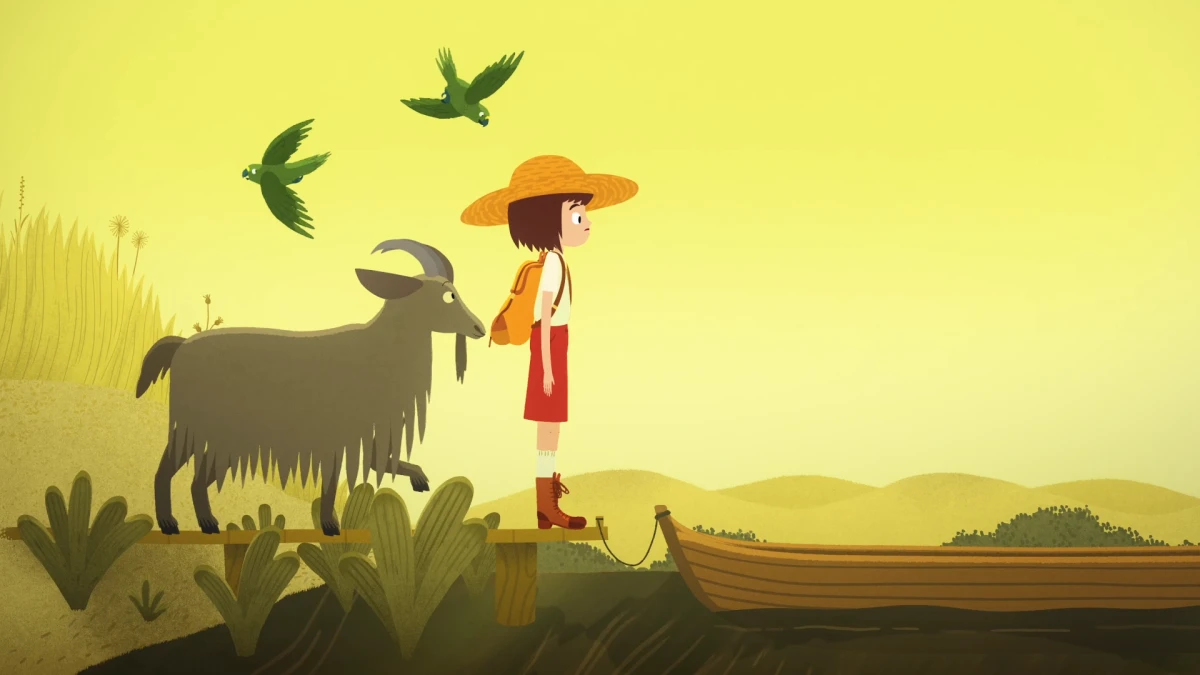
Andersone: We were delighted to have the world premiere of BORN IN THE JUNGLE in the Annecy Presents section. I’d expected a family audience with children, but there were mostly professionals. The film is set to premiere in Latvia on 18 August, and our sales agent, Dandeloo, has already sold BORN IN THE JUNGLE to at least 24 territories, including France, Sweden, and Spain. While we are campaigning for the release, we have secured financing for a short film, and we are currently in production on a mini-series.
If all this works out well, next year you might finally be able to afford the Rolls-Royce.
Andersone: BORN IN THE JUNGLE is set in Venezuela, and the situation there is tragic. On the day of the international premiere, Venezuela was hit by a massive earthquake. We started from the real-life story of a Latvian family who lived in Venezuela in the 1950s. That’s how we came up with the idea: how did these children feel about their parents’ decision to move to the jungle? Did they accept it or not? We were unable to do any on-site research because travelling there wasn’t an option, but we had always hoped to visit one day. And now this… Instead of thinking about a Rolls-Royce, my thoughts are with the people there.
Gert Hermans


