

CEEA Talks: Producer Kristina Husová on EENY, MEENY, MINY, MOE!: “I value close collaboration over rapid growth”
High up in the clouds, the young children of Greek goddesses, gods, and monsters come together to play. That is where EENY, MEENY, MINY, MOE!, the Czech-Slovak animated film by Andrea Szelesová (and former participant in the CEEA Workshop), begins. From there the gods observe the wretched life on Earth. Just as producer Kristina Husová (Pure Shore) looks down from the rooftop terrace on the teeming crowd in the square: families with children celebrating the 66th edition of the Zlín Festival under a glorious sun. Is it simply the producer’s job to ‘find the money’, or do they also have to be an expert in Greek mythology these days?
Do you know the names of all the gods and goddesses in the film?
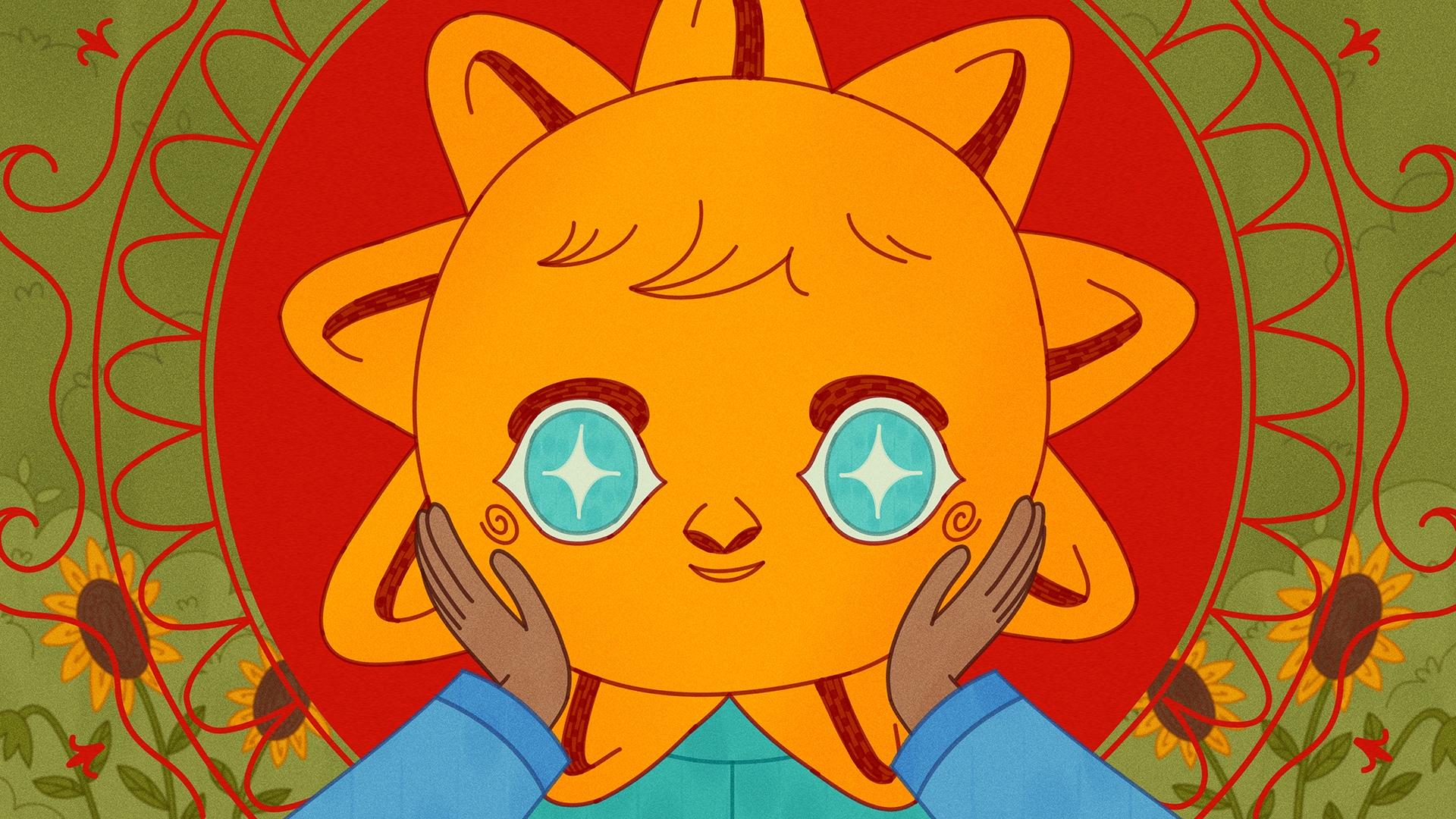
Kristina Husová: Of course! During the development phase, we conducted research into the various interpretations of Greek mythology, but in the end we took a more flexible approach; we didn’t interpret the stories literally; however, we stayed a bit closer for our well-known characters, such as Medusa and Helios. Andrea Szelesová is an animator at heart; her initial motivation for this project was visual. When she first approached me at Anifilm, five years ago, she told me about an image she had in mind: a little, lonely Sun-child, sitting on his own. Searching for a fitting context for the story, we turned to Greek mythology. The film is full of small references, such as an allusion to Icarus flying too close to the sun, while in the background you can spot all kinds of unnamed monsters going about their daily business.
That multitude of characters reminds me of paintings by Pieter Bruegel, or a page from Where’s Wally?
Husová: In her graphic style, Andrea was strongly inspired by Minoan culture; she tried to capture the playfulness she found in the colourful frescoes of Knossos and Akrotiri. But our main inspiration was SON OF THE WHITE MARE (1981), a Hungarian animated extravaganza by Marcell Jankovics, which is full of mythological references, with a similar contrast between light and darkness.
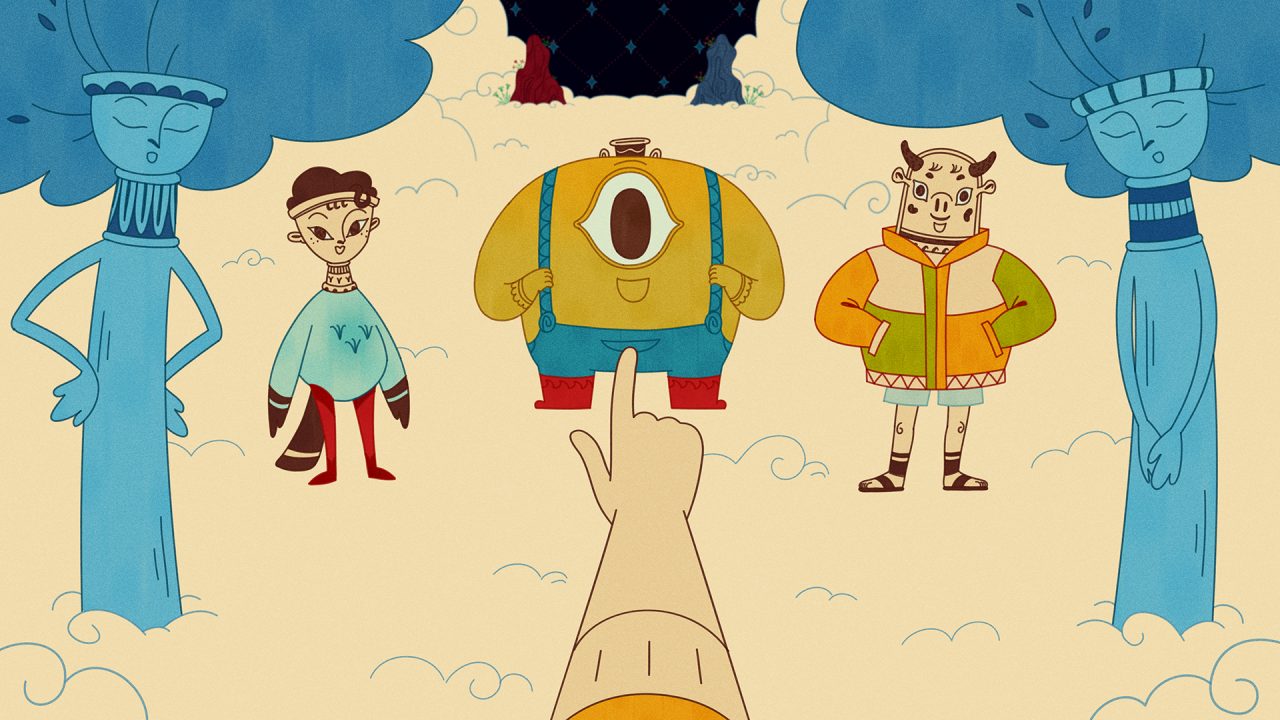
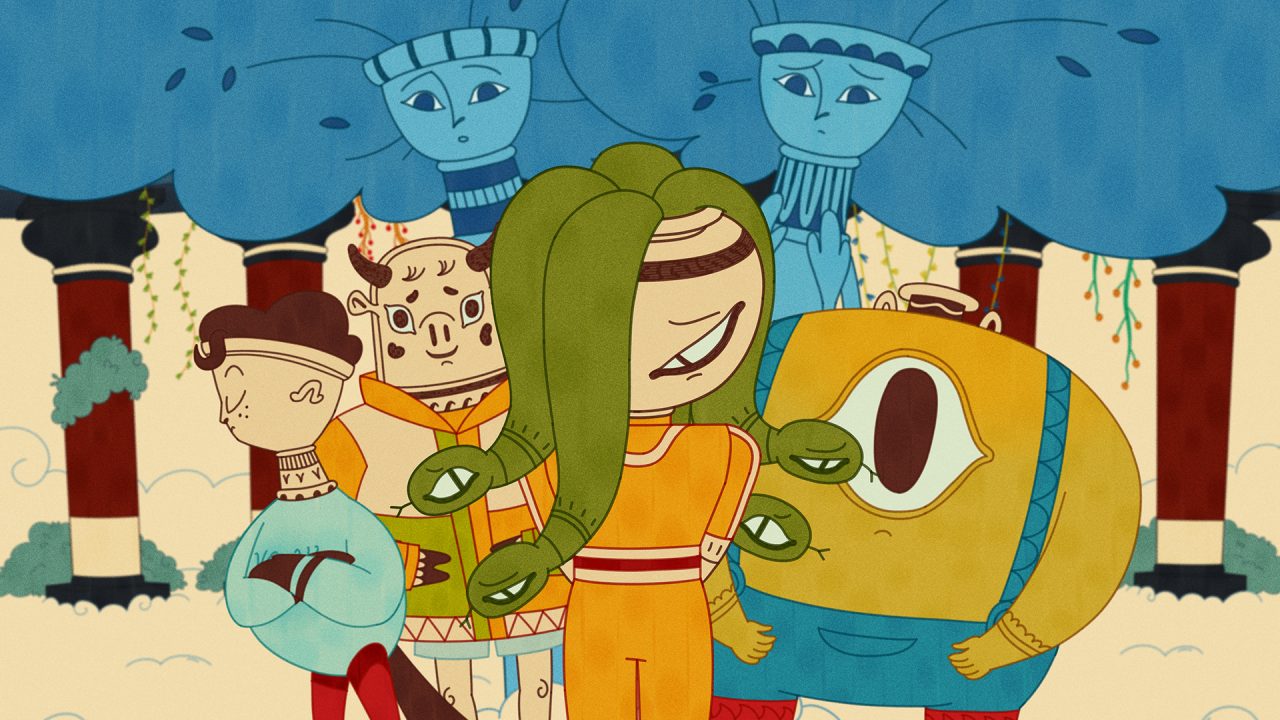
Greek mythology apparently lends itself perfectly to hilarious jokes, such as Helios arriving to the sound of roaring engines.
Husová: We assumed everyone would be familiar with the major European mythologies, but during development we discovered that young kids aren’t nearly as much into it as we used to be. When we asked a few children, we realised their connection was very limited. Today, Star Wars or The Lord of the Rings are just as much mythological worlds for children to explore as Greek mythology once was for us. With that humour, we’re catering to a generation of children who aren’t familiar with the world of Greek gods.
We spent the first few minutes of the film in a playground, and I got the feeling it was the director’s playground as well; a place where she was having great fun.
Husová: For Andrea, that was another starting point: a playground high up in the sky that we can’t see from Earth. She came up with many additional character ideas that often were expanded by background artist Andrea Arce. Out of that whole bunch of characters, my personal favourites are a little Pegasus, a horse-shaped balloon floating around on its mother’s leash, and Little Death. During production, I gave birth to my daughter Jasmina, and I asked Andrea to create a character wearing a baby sling as a humble tribute to working parents caring for their children. She came up with a tiny Grim Reaper carrying a baby on his back, and I loved it.
I guess Andrea made life difficult for herself when she decided to give her main character a halo, which makes the design a lot more complicated!
Husová: We both underestimated how much work that was. Andrea thought she would add the halo as a finishing touch once the animation was done, but in the end she spent two full months working on it. During a final test screening, we spotted many tiny mistakes in the halo, almost invisible to the naked eye; only when we paused a shot on the big screen could we notice a single stray pixel. Andrea – “It has to be perfect; otherwise, I’ll never be satisfied” – redid nearly 100 shots, just to make it in time for the Berlinale. It was a bit of a nightmare, but we learned a lot from the experience. If we ever turn this film into a series, we’ll be well prepared.

Then you took the film to Berlin.
Husová: From the very beginning, that was our main ambition. I love Berlin! I had a film there in 2025 – STONE OF DESTINY by Julie Černá – but this time we were targeting the Generation section, where they genuinely care about children’s films in a way I’ve never experienced at any other A-list festival. Seeing 400 kids jump off their seats, fully immersed in the story, was a lovely experience. Since our world premiere, the film has been screened in more than 30 festivals, and we even went to Tribeca! EENY, MEENY, MINY, MOE! was selected there by Whoopi Goldberg for the Wonderful World of Animation (in which we received a Special Jury Mention), as the first Czech or Slovak film ever.
In 2024, you brought EENY, MEENY, MINY, MOE! to the CEEA Workshop.
Husová: It was the first time for me as a producer, and for Andrea as a director, so we didn’t know what to expect. And as we are both overachievers, in the run-up to the workshop, we read all the materials, every word; we took notes, and wrote extensive feedback. We quickly realised we over-prepared – it was a little embarrassing. My six-month-old daughter came, along with my husband, so the whole family was there. But the timing was perfect for us; we already had a final version of the script and even an animatic, though at first we didn’t dare admit we had one. So our sessions focused on concrete elements. Right after the workshop, we went straight into production.
Why was that timing so important?
Husová: You have to consider carefully which project you bring to the Workshop and at what stage. For example, if you are in a very early phase, receiving feedback can be frustrating, because you don’t have a solid structure in place, and everything risks falling apart. It’s also important that the director is open to change, because the workshop is very inspiring but can be quite invasive, and you need to be prepared for that. Some projects in our group explored personal or traumatic childhood experiences. Suddenly discussing all of that in front of a group can be quite intimidating.
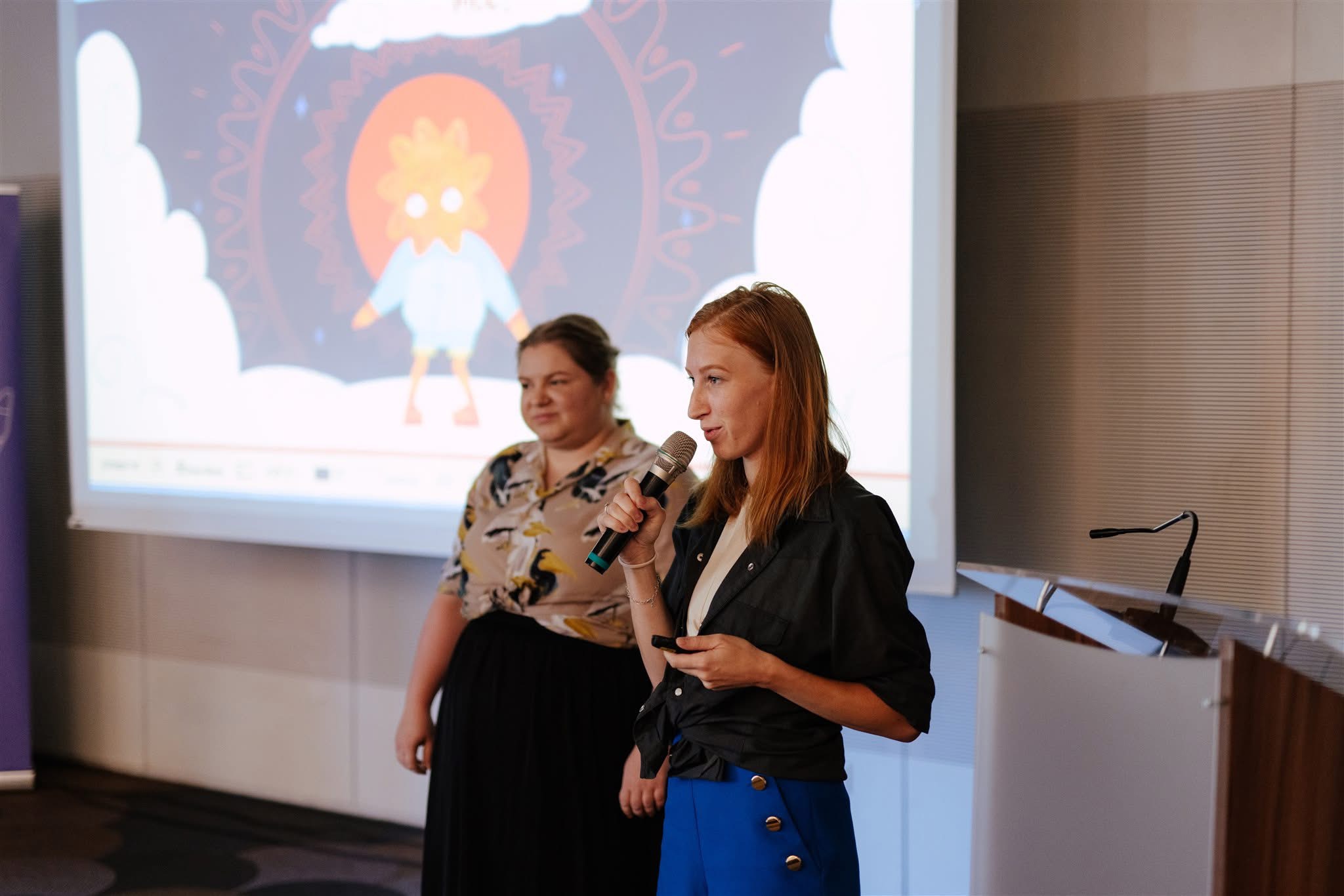
With Pure Shore, you’re now running your own company.
Husová: While working as a freelance producer for other companies (such as Cinepoint or Moloko Film), I founded Pure Shore in 2024. We currently have three animated shorts in circulation. Our first title, HUMANITY by Tereza Kovandova, was sold to Canal Plus and just a week ago received its 16th award; STONE OF DESTINY was acquired by Arte and has been selected to almost 90 festivals, and EENY, MEENY, MINY, MOE! is our third release.
One thing you emphasise in Pure Shore’s profile is your commitment to international co-productions.
Husová: My ambition is to find new talents and new companies for long-term collaborations; this is where I find my motivation. At the CEEA Workshop, for example, we immediately clicked with Draško Ivezić from Adriatic Animation. He showed me a short film he was developing, and now we’re co-producing it! The core of the company is building an international network of like-minded people who trust and understand one another. I met several of them through the Workshop or other CEEA activities, as they tend to bring together just the right people. Strong friendships grew within our group; this is at the very heart of the Workshop’s concept and perhaps its greatest strength.
That philosophy seems to go hand in hand with your ambitions for Pure Shore.
Husová: Whenever someone comes to me with a project, I tell them that I see international co-production as the only natural way of making films nowadays. If they’re not interested in working internationally, I’m probably not the right producer for them. Creatively, strategically, and financially, co-production strengthens a project. It brings together different expertise, talent, and resources, while giving a film wider international exposure. Just as importantly, it builds lasting professional relationships in which everyone learns from one another. Pure Shore is intentionally a small company because I value close collaboration and shared values over rapid growth. Sustainability is a key value for us, not only in terms of green strategies but also in building sustainable partnerships that last well beyond a single film.
Was EENY, MEENY, MINY, MO! a good example of that work ethic?
Husová: I certainly hope so! Cinepoint and Pure Shore co-produced the film with Ansze, Andrea Szelesová’s company in Slovakia. From the outset, we conceived it as an international co-production, and as co-producer, Andrea was a natural part of all decision-making. We received support from the Creative Europe MEDIA programme, the Czech Film Centre, the Slovak Film Institute and the Endowment Filmtalent Zlín. Finally, the PPF pitching at Anifilm closed the last gap in our financing, about four months before production wrapped.
You tapped into every possible funding source.
Husová: In the Czech and Slovak context, especially for short films, funding opportunities are limited, so combining several sources is often the only way to build a viable budget. I don’t see that as fragmentation, but as a sustainable financial model that allows a film to realise its ambitions and reach its international potential.
You believe that collaboration gets you further than competition.
Husová: I’m not the only one who feels that way! Czech animation producers may all operate in the same field, but it rarely feels like “them versus us.” It’s more an “all of us together” mindset. A success for Czech animation is a success for the whole community, strengthening everyone’s international position. In the film industry, the spotlight is often on live-action productions, where scale and ambition can lead to fierce competition. In animation, I feel there’s more room to experiment and support one another. Rather than competition, there’s often a genuine sense of shared achievement when someone succeeds.
What is the most important lesson you’ve learned as a producer?
Husová: Know who your target audience is, and think from the very beginning about how you’re going to reach them. At Pure Shore, we make films for different audiences: children, young adults and adults, so it’s essential to have a clear sense of who a film is for. We’re currently developing our first 3D-animated feature: ACORN’S ADVENTURE, co-produced with Fabian&Fred, is the biggest animation project I’ve worked on so far. We’ve presented it at several international markets – the Cinekid Junior Co-production Market, MIFA in Annecy, Cartoon Movie, where it received the Eurimages Co-production Development Award, and Berlinale Animation Days. Each of these platforms gave us valuable feedback from sales agents and distributors, helping us understand how the story is perceived internationally. That feedback has inspired new approaches to the story and even helped us refine our target audience. In parallel, together with director Filip Mašek, I visit schools and run workshops with children to see how they respond to the project. What do they understand? What makes them laugh? How do they evaluate the story? That’s the best way to make sure we’re creating the film for the audience it’s intended for.
Gert Hermans


