

CEEA Talks: Jure Bušić on Animation in Croatia
If it sometimes feels like too few animated films are coming out of Croatia, it’s worth noting that one man is doing his part to change that, with no fewer than eight projects currently in development. Jure Bušić (Jaka Productions) is making the most of every opportunity: he’s pitching at the CEE Animation Forum, participating in the CEEA Workshop with BROTHER DEER, and meanwhile, working towards something larger, a stronger, more versatile Croatian animation landscape.
Is there a better way to shine a spotlight on Croatian animation than through the man who is represented at the CEE Animation Forum twice?
Jure Bušić: I was surprised! I applied with two projects, and didn’t expect them both to be selected.
Jaka Productions isn’t exactly known as a company specialising in animation, but on stage, you said you currently have eight (!) animation projects in the pipeline.
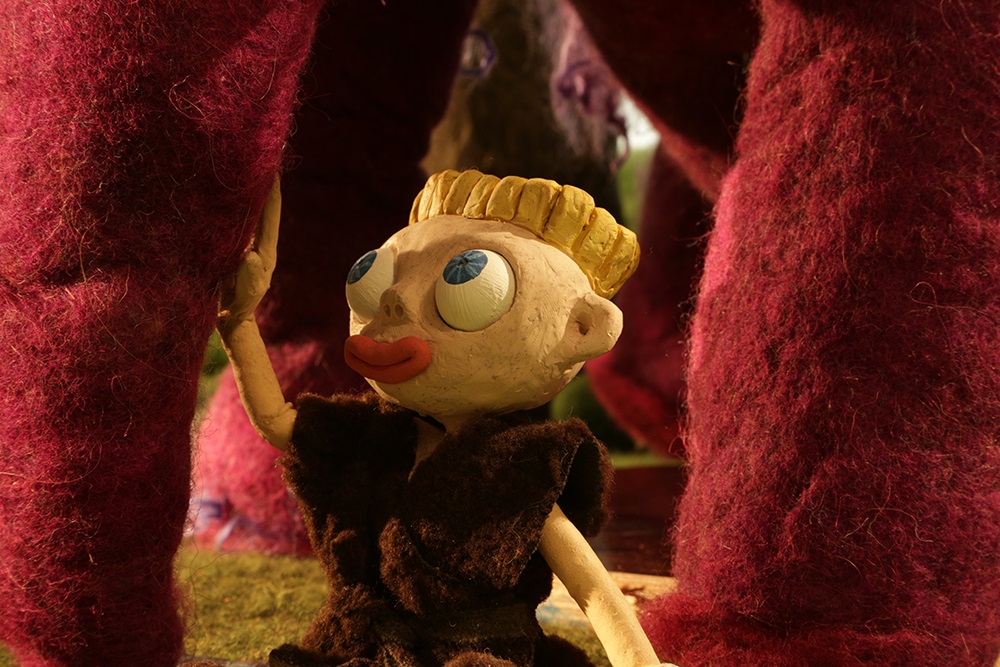
Bušić: My father was a painter; perhaps that is where my childhood fascination with pictures and animation comes from. But it was never a part of my career plan; I mainly worked with live action and documentaries. Until I produced my first stop motion short film seven years ago, THE BALLAD OF PIPE AND NECKLACE by Martin Babic, and found it both exciting and relaxing. Live action often requires a large crew, perhaps as many as 100 people, whereas the process for an animated film is much more peaceful.
Do you mean that producing animated films is for lazy people?
Bušić: Definitely not! It requires time and patience. Every project brings new challenges, different authors, different techniques… It’s always a matter of experimenting. I take care of the festival distribution for my shorts, and was surprised by the number of festival selections for THE BALLAD OF PIPE AND NECKLACE. For live-action shorts, I struggled to find 20 festivals. But my first animated film was selected for more than 100 festivals and collected 10 awards. The same applies to our latest film, THE SHADOW, by Petra Balekić. Animation travels so easily! Afterwards, several animation filmmakers approached me: “You did a great job for Martin Babic; we want to work with you too.” And here I am, with several animated titles in production.
Do they all come in different styles and for different target audiences?
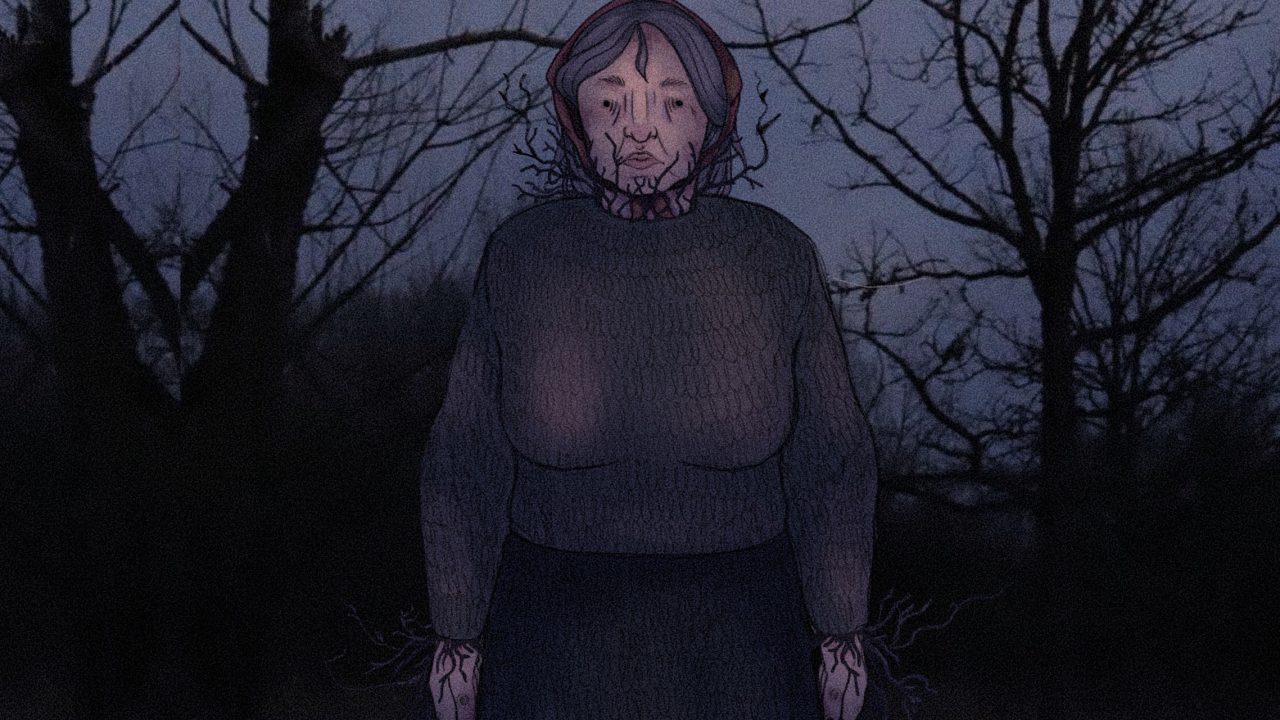
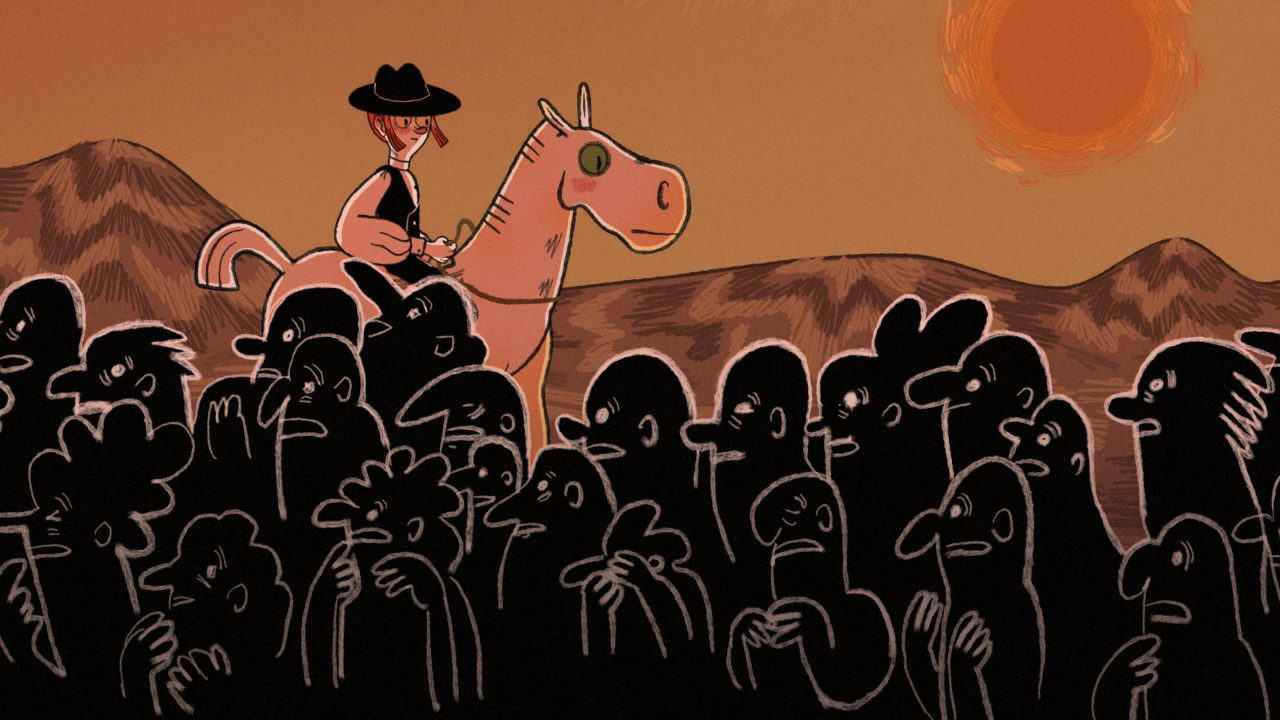
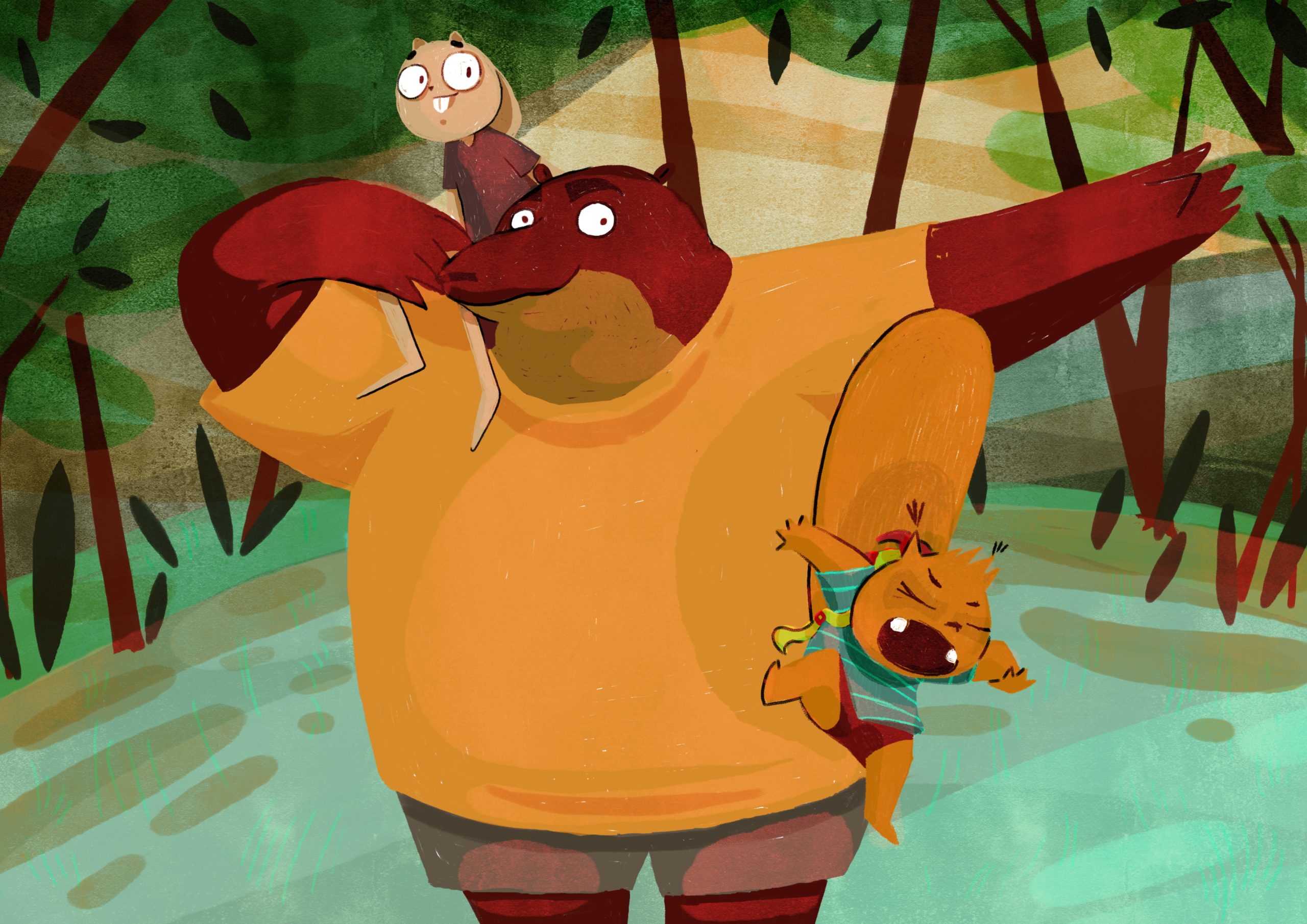
Bušić: Most of them are 2D animations, one is in 3D, another combines stop-motion and 2D, and Martin Babic is working on a new stop-motion project. EVERY TUESDAY AND FRIDAY by Dora Pejić Bach received an award at the CEE Animation Forum, and the short film SCHERZO is directed by emerging talent Dorotea Radušić. For both projects, we are looking for European co-producers. This year, we completed two Slovenian shorts, which are now beginning their festival run: THE GIRL WHO WASN’T AFRAID OF BEARS by Lea Vučko, and IN A FARAWAY FOREST: APPLE OF DISCORD by Timon Leder. All of these projects can serve as a stepping stone towards producing a feature or a TV series. Animation has a strong artistic aura in Croatia, and these artists are not used to working with the larger crews required for feature production. That’s why short films remain a way to build a high-quality talent pool for more ambitious projects in the future.
Can you find such talent in Croatia?
Bušić: For sure, primarily in 2D animation. Every year, 10 to 15 students graduate from the Animation Department at the Academy of Fine Arts in Zagreb. That’s quite a contingent of skilled artists! Thanks to my background, I’m also well-connected to Slovenia. Both capitals, Zagreb and Ljubljana, are no more than 1,5 hour apart by car. In terms of distance, combined talents, and combined financial support, these countries are ideal co-production partners. For A LOYAL FRIEND, presented at the Forum, we already have the Slovenian animation studio Invida on board, and have made connections with a Czech co-producer.
Compared to other Central European countries, what is the historical profile of Croatian animation?
Bušić: As a part of Yugoslavia, Croatia was well represented on the international scene in the 50s and 60s. In 1962, Dušan Vukotić’s SUROGAT made history as the first non-American film to win the Oscar for Best Animated Short. A vibrant scene formed around the Zagreb School of Animation. All those people were closely connected in a community where ideas were exchanged and discussed. That was truly unique! Croatian animation was known for its artistic shorts, but several children’s series were also internationally successful. That great tradition lasted until the 80s, when a new political era began.
What is left of that scene nowadays?
Bušić: We still produce a lot of artistic shorts, but we lack projects with commercial and worldwide distribution potential; no feature animations or high-quality TV series. This is what is needed to build up an industry with people who are aware of the latest trends and used to working with large crews on ambitious projects. Only that can lend us more international visibility.
Can the Croatian Film Fund provide support through a distinct animation policy?
Bušić: The distinct calls for animation mostly concern shorts; at the moment, in Croatia, feature animation shares the same call with live action. In the CEE region, in general, I see national film funds investing too little money in animation. In my opinion, each fund should at least have a separate call for feature animation.
Nevertheless, a successful animated feature did emerge a few years ago!
Bušić: CRICKET & ANTOINETTE by Luka Rukavina and produced by Dino Krpan for Diedra Productions, was a major box office success in 2023. With 85,000 admissions, it became the second most successful Croatian film of the year, after the live-action THE DIARY OF PAULINA P, which I produced. It was the first animated feature made in Croatia in at least a decade. So what more incentive does an Audiovisual Centre or Film Fund need to invest in feature animation? The audience is waiting for it!
Now the same director signed up with you for a new project?
Bušić: When we had the first version of the script for A LOYAL FRIEND, I called Luka. He is an experienced director and excellent storyteller. I applied for funding, and am waiting for the results – one thing about feature animation is that it teaches you patience. Luka previously worked in 3D, but this time we’re aiming for 2D. We want to work with local artists, Croatian and Slovenian animators, who can bring a distinct regional flavour. That’s something we feel is easier to achieve in 2D than in 3D.
Your other project presented at the Forum is called BROTHER DEER.
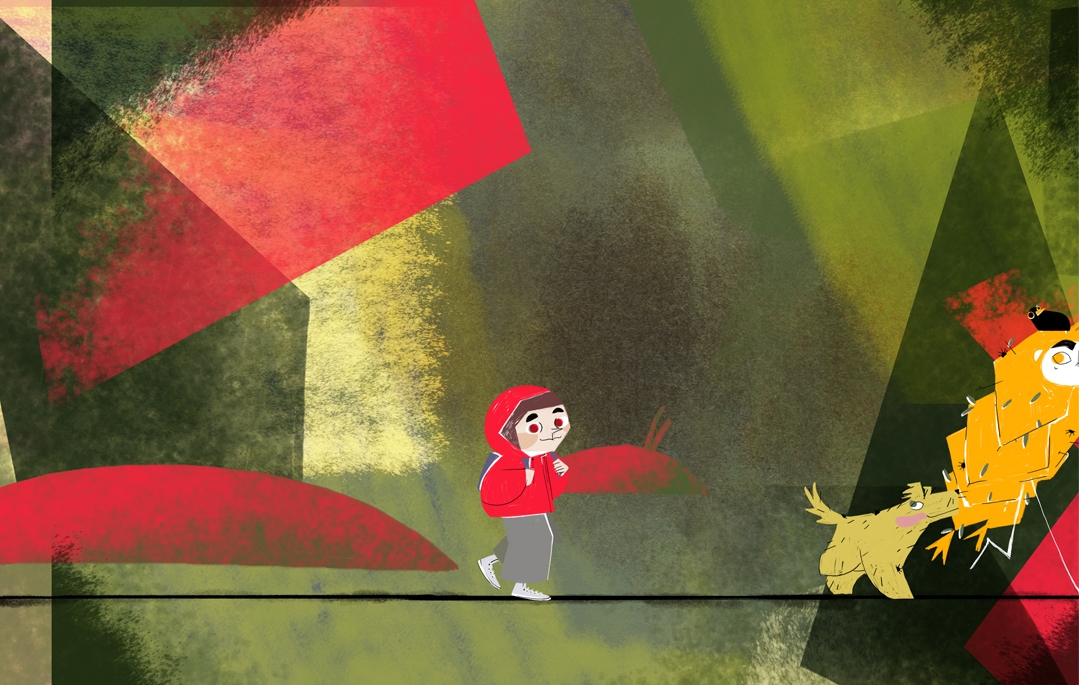
Bušić: BROTHER DEER will be a TV series by Lucija Buženčić, a talented Croatian director and animator. It is based on a literary classic over 100 years old, a solid IP that remains very popular in our region, especially in Croatia. We’re investing in the development, and Lucija’s persona adds significant artistic value. After our first presentation at the CEEA Forum, reactions were very encouraging. That’s the most incredible thing about this forum: getting all the feedback from international producers. If they understand and appreciate the project, that is a good sign.
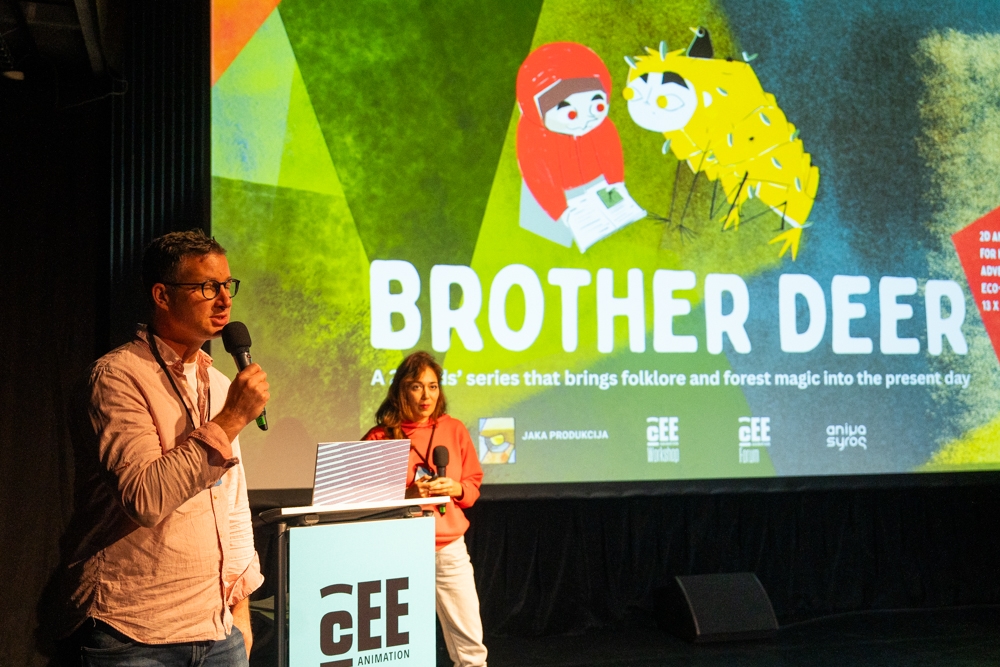
BROTHER DEER has a strong connection to CEEA, as it participated in the Workshop.
Bušić: My first time at an animation workshop was a very good experience. Throughout the meetings with our excellent tutors in person (in Nova Gorica and Lodz) and online, we took time to consider and fine-tune every aspect of the project, which is super important for an animated series. Now we’ll take the project to Stuttgart and Annecy, where we’ll present BROTHER DEER at the market. We go step by step!
What do you find more challenging as a producer: an animated feature or a TV series?
Bušić: It all depends on the financing. An animated feature often has a better chance of securing funding and international distribution. The current trend among television channels is to commission a large number of episodes, often as many as 52; that volume of content is almost impossible to produce for a low-capacity country. When counting in total runtime, a feature can be less demanding, especially when supported by a national film fund and international co-production partners. For a series, you also need a strong national broadcaster on board. Despite their interest in animation, particularly for children, they’re not investing as much as they should. Quality animation travels well; it can be both a strong investment and an effective promotional tool for a national broadcaster.
Besides support from the schools, the national policy, and the broadcasters, what else do you need to give Croatian animation a final boost?
Bušić: I told you about the 60s, when we had this animation community. At the CEE Animation Forum, I feel how useful it is to exchange ideas and connect with colleagues. I would love to see that happen on a national scale. I want to see more series and features produced, and more service production for international titles; that will help us gain experience. And maybe one big international success – that could make a difference.
Gert Hermans


