

CEEA Talks: Hisko Hulsing on DANSE MACABRE: “We thought we were so great and indispensable”
‘Branie’ is a Dutch word, Hisko Hulsing’s mother tongue, that is difficult to translate. Translation tools suggest ‘swagger’ (too smooth), ‘cocky’ (too macho) or ‘full of himself’ (completely wrong). But it perfectly characterises Hisko Hulsing: he has guts, possesses old-fashioned craftsmanship, and isn’t afraid to convince the world of it. And with DANSE MACABRE, he has made an impressive film, based on the Allegro from Dmitri Shostakovich’s 10th Symphony.
The commotion surrounding the film placed Hulsing in the eye of the storm, and that seems to have affected him deeply. Surprising for a man who seemingly couldn’t care less about conventions – branie, remember? Perhaps it’s because the whole controversy missed the essence of his artistry: the creation of compelling, powerful and overwhelming cinema.
You described seeing Pink Floyd’s THE WALL at the age of 15 as a turning point in your life. I had a similar experience at that age, although I’m not sure I could sit through the film now.
Hisko Hulsing: Today, the film comes across as rather bombastic, full of self-pity and with the dubious message: “We don’t need no education.” Education portrayed as a fascist system that puts children through the meat grinder – that’s not what you want to pass on to young people. But at the time, I was a dropout, had just been kicked out of school and spent all day stoned, so I completely identified with that film. It wasn’t good for my mental health.
So what good did the film do for you?
Hulsing: I started looking at reality as if it were oil paintings on canvas. Around that time, I began painting myself. With oil paint, you can create a kind of realism that is at the same time full of suggestion. That laid the foundation for all my animation work.
Which means you’re carrying on a very Dutch tradition!
Hulsing: I have always been fascinated by Old Masters like Bruegel and Van Eyck, and my artisanal foundation lies with painters of the Dutch Golden Age, such as Rembrandt and Vermeer. Their painting technique is very simple. At art school, a whole mystique was created around it, but really, it’s just wet-on-wet, the so-called alla prima: a technique that gives a strong suggestion of realism and allows you to work very quickly. I’ve become a virtuoso at it. I can paint anything you ask me to. Drawing is much more difficult. As Salvador Dalí said, drawing is the honest part of painting: it’s about insight and exact proportions; painting is mainly technique.
You believe in traditional craftsmanship, but you also embrace new technologies.
Hulsing: Technology allows us to extend our bodies: the hammer that lets us drive a nail into a piece of wood, the brush we use to make a painting. Throughout history, every technological breakthrough has met with a great deal of resistance. But the latest development is a thousand times more impactful. I see AI as a funhouse mirror for humanity: we thought we were so great and indispensable, but apparently, that’s not quite the case. We risk losing our human dignity. My film is about the resurgence of fascism. AI makes people feel as though we are submitting to the machine. That, too, is a form of fascism.
Are we slaves to technology?
Hulsing: In KOYAANISQATSI, one of my favourite films, director Godfrey Reggio argues that we don’t just work with technology; we have become part of it. In 1982, when the film came out, people didn’t feel that so strongly yet. But today, we are completely obsessed with the little screens on our phones. Even more than in the 1980s, we have submitted ourselves to technology.
But what technology still cannot do is what Shostakovich could. What is the essence of his 10th Symphony, which you linked to your own war myth?
Hulsing: All his symphonies are about human suffering and the forces that destroy humanity. You can feel that in his music. In his 13th Symphony, for example, he refers to Babi Yar, the mass murder of Jewish victims by German troops in Ukraine. He smuggled such themes into his music, while trying to evade censorship and please Stalin. In the end, he himself was crushed by that gigantic Stalinist machine. He was an alcoholic and under constant pressure, because Stalin could arbitrarily put you on a pedestal and just as quickly knock you off it, with fatal consequences. It’s all in his music. To compose a piece like that, you have to be Shostakovich. You can imitate it with AI, but then it becomes meaningless.
And what did you do with it?
Hulsing: I created an interpretation because I think I know what the piece is about. As a young man, he sometimes made illustrative notes on his scores: “Here, a soldier crawls out of the trench.” To me, it was all clear: the snare drums that sound like machine guns, the pounding of horses’ hooves! I’ve been immersed in music all my life. My son and my partner are violinists; I’ve composed for orchestra myself, and my father held an administrative position with the Netherlands Philharmonic Orchestra. If the Queen didn’t show up for a concert, my brother and I would sit in the royal box. Animation is fun, but music is the most beautiful thing there is.
The structure of the piece of music is strictly binding; the structure of your story is subordinate to the music.
Hulsing: The music is the guiding principle; the music is the script that determines all my artistic choices. Even if that means you already have a climax halfway through the film.
But at the end, we are not given peace or redemption.
Hulsing: Certainly not. Once, I travelled through northern France, where the First World War raged particularly fiercely. You can still see shell craters in the meadows. We came across a site where a general had ordered his troops to capture the area within 24 hours. In the end, it took them a year, and 100,000 soldiers died on that field. My film is not about people defending their rights or their country; it’s about militarism and fascism, about digging up demons from the past to justify today’s war. The muses who urge the soldiers on in my film are today’s propagandists.
You feel quite at home in that grim playground. Are you making the film out of fascination, or out of a genuine aversion to the horrors of war?
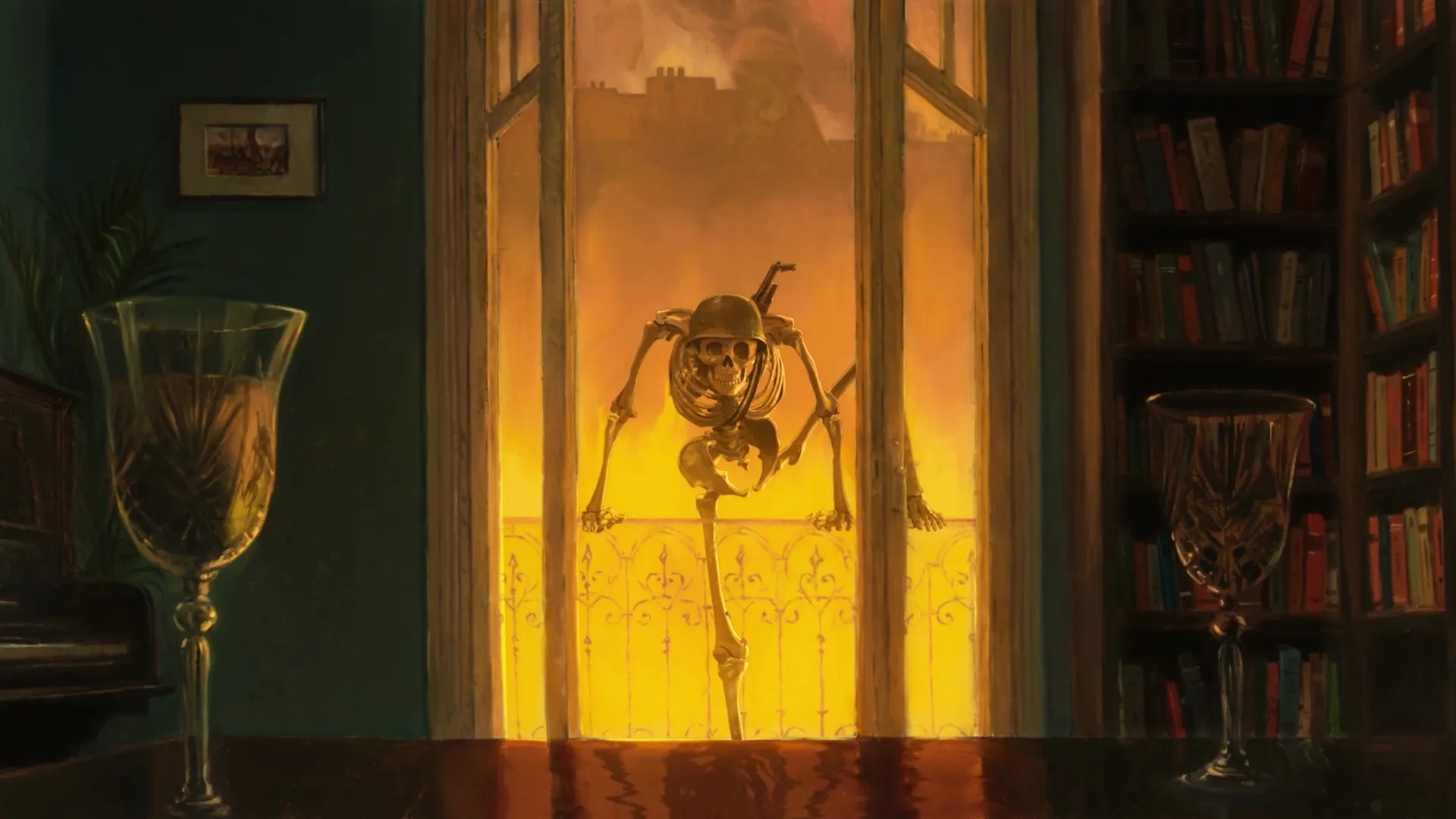
Hulsing: One of the working titles of this project was THE SPECTACLE. I remember the first Gulf War, when you could watch Baghdad being bombed on CNN in real time. That was a form of entertainment, a spectacle that people watched as if it were a Hollywood film. That’s why my film begins and ends with the image of a theatre. That layer of meaning is more relevant than ever. Trump’s propaganda on social media, the demonisation of the Iranians… It’s a huge theatre. Analysts literally call it a “theatre of war”. You can’t make up the horror and brutality of the First World War or the Stalin era, no matter how morbid your imagination is. In the film, a dead soldier is brought back to life by the muses. His face turns into a skeleton. Because when soldiers leave for the front, their fate is already sealed. Like Russian soldiers being sent to Ukraine: the moment they get on the train, they are essentially already dead. That’s what I’m trying to portray in the 4.5 minutes I’ve been given.
FANTASIA it ain’t!
Hulsing: Although it did inspire me! There were three things on my moodboard: Francisco Goya, THE WALL and FANTASIA. Recently, I was approached by a major American producer who said, “It reminded me so much of NIGHT ON BALD MOUNTAIN from FANTASIA, but better.” Hallelujah, he got it!
You had to animate skeletons… And not just a few! Can you put expression into a skeleton?
Hulsing: Not in the face, but in the movement. Some people said beforehand: your film is going to be amazing, but only if it’s drawn in 2D. I thought: well, that’s easy for you to say… How am I going to animate 1,000 skeletons, with all those ribs? That has to be done in 3D! I didn’t want a slick film; it had to be grim. The skeletons clinging to horses and then falling off, or drunken skeletons dancing around the fire – that’s expressive animation. We shot everything beforehand with actors, musicians, and stunt performers in live action. For the first time in my life, I had an AK-47 on set! And we had a Marine and musicians there to give the animators enough reference material.
Let me take you into the minefield of recent events through a musical link. You know what happened to Bob Dylan at the Newport Folk Festival in 1965: he was booed for walking onto the stage with an electric guitar. For the sake of convenience, could you briefly summarise what happened to you in Annecy?
Hulsing: Two weeks before the festival, where DANSE MACABRE was playing in competition, my trailer went viral. That was promising! Until suddenly comments started appearing about the use of AI in my film. I had spoken openly about it in the making-of video, and I became a victim of my own honesty. AI is only a small part of the film’s pipeline (as you can see in the ‘Anatomy of a shot’ video), but a campaign group sent an open letter to the festival demanding that films using AI be rejected.
Can you take me through the technical details?
Hulsing: For DANSE MACABRE, I made 79 oil paintings. They were brought to life using traditional methods by 30 animators in four countries. Only a small part – the textures of the moving elements – was created in ComfyUI. Based on that, people decided to make DANSE MACABRE the whipping boy. Annecy had to become the battlefield where the war would be fought.
How did that happen?
Hulsing: Anti-AI stickers were handed out. Before my film had even started, part of the audience walked out of the screening room. I saw it happening and naively thought: maybe they have to go to another screening. But apparently people had been encouraged to leave as part of an organised protest. After the screening, around 100 people started booing. A woman shouted, “Shame on you” and “AI is stealing our jobs”, while the credits were rolling, with the names of at least 80 people who had found work thanks to the film. I shouted back, “We created jobs!” But nobody could hear me in the uproar. When my name was announced, the booing started again, so I stood up, said thank you and gave them the finger. I will never apologise for that, because those anonymous shouters hadn’t done their homework. If they had taken one minute to look up my name, they would have known I’m a craftsman, not an AI clown, or whatever they want to call me.
The Annecy Festival stood up for you.
Hulsing: Artistic director Marcel Jean issued a press release condemning the witch hunt and calling me a respected artist. I also received support from all kinds of people I have enormous respect for: Joanna Quinn, Chris Landreth… But after the press release, a second wave of criticism began. A few days later, there was a third wave, when a campaign group posted the video of my reaction, and other organisations picked it up. In the end, 10 million people heard about my film. People sometimes say there is no such thing as bad publicity, but that’s not true. Because with a few exceptions, nobody ever talks about the film. It’s exclusively about this whole AI business. That’s frustrating, even though DANSE MACABRE thereby became the most talked-about animated short of the year.
You claim that, as an artist, you want to retain full control. That’s not a contradiction?
Hulsing: There is no such thing as complete control. When I made UNDONE, which involved at least 200 people, I learned that bad art directors micromanage; they tell you exactly what to do, which makes you freeze up and afraid to take any risks. A good art director sets certain parameters and boundaries, but within those, you have freedom. It’s about daring to embrace things that lie outside your sphere of control and that improve the project. If everyone just does whatever they want, it’s not going to work. It’s all about balance.
DANSE MACABRE was an international co-production. What exactly was the Hungarian contribution?
Hulsing: Réka Temple invested her own money through Cinemon Entertainment. I’m enormously grateful for that. She felt it was important to make the film. The animation of the muses — the propagandists who send the skeletons onto the battlefield — was done in Hungary. This was still under the Orbán regime, although we didn’t receive any government funding. I found that rather ironic. The collaboration with Réka and the team of animators was fantastic. If I make another film and they still want me, I’ll work with them again in a heartbeat. The other co-production partners were Valk Productions in the Netherlands, Autour de Minuit in France and Vivi Film in Belgium.
You gave a presentation today to the participants of the CEE Animation Workshop. How can you inspire them?
Hulsing: What I tell young people is that it’s good not to focus on one particular skill. What good is it if you’re the best rigger in the world? Or the best modeller? You don’t know whether there will still be a demand for that in three years. A broad skill set and development give you more opportunities to find work, and a richer life. I speak from experience.
Your partner and your son are violinists. And you’re presumably the first person in history to have a violin turned into a gun. How did you get that past them at home?
Hulsing: Because of its meaning in the film. The muses are the inspirers behind the violence of war. It doesn’t always have to be Trump, Putin or Netanyahu sending people down the path to war; it can also be a musician or an artist. Remember the international conflict sparked by the publication of the Danish cartoons depicting Muhammad? Or the massacre at Charlie Hebdo? My first reaction was: how can you kill cartoonists? Aren’t they innocent? But sometimes the pen is mightier than the sword. The violin turning into a gun represents art and entertainment being used for propaganda purposes.
Gert Hermans


