

CEEA Talks: Eric Reginaud about CICLIC
“When you say co-production, you say Central Europe”
If CICLIC did not exist, someone would have to invent it. Anyone who looks at the full range of activities of this French audiovisual agency cannot help but be impressed: literature, film education. Yet it plays a particularly important role in animation, mainly through its residency programme, which offers filmmakers the rare luxury of time and space to develop their projects. Every year, Eric Reginaud brings that opportunity to the CEEA Forum, inviting new talent through the CICLIC Award.
One CICLIC tagline that particularly struck me was: “From local to international.”
Eric Reginaud: That really sums up what CICLIC stands for. We are the film and audiovisual agency of the Centre-Val de Loire region, dedicated to supporting cinema (including animation), literature, and digital creation. The idea is to connect regional artists with international professionals and create a network, particularly in animation. By supporting international projects and inviting foreign guests to our residency, we introduce regional artists to a wider scene. Since launching the residency, local producers have begun to recognise the enormous potential of animation and have started developing more animated projects. Some companies have even moved to our region, such as Ikki Films and GASP!, which were initially based in Paris but now have a permanent presence in Centre-Val de Loire.
Please tell me where Centre-Val de Loire is?
Reginaud: It’s a region just south of Paris and the Île-de-France. The Loire River flows through its six departments. The capital is Orléans, and the biggest city is Tours.
That sounds rather rural.
Reginaud: Very rural indeed! Filmmakers staying at our residency get to breathe the countryside atmosphere. The idea was to create a kind of haven where people can work in peace. Ten years ago, the residency moved from Château-Renault to Vendôme, to a building that had been renovated to meet the specific needs of animated filmmakers. Vendôme is a small town with a rich cultural life, but if residents suddenly long for the big city, Paris is only 40 minutes away. All filmmakers supported by CICLIC eventually spend time in residence. Feature films and TV projects (series or specials) in development stay for at least two months, while short films spend up to six months working on the animation. By request, they can stay longer. For example, directors Ange Potier and Eleonora Comelli, working on the French-Argentinian project LA MUJER PARECIDA A MI (Girelle Production & Matiz), will stay in residence for a full year.
For several years now, you have presented an award on behalf of CICLIC at CEEA’s Animation Forum. The winner of that award is invited to stay with you.
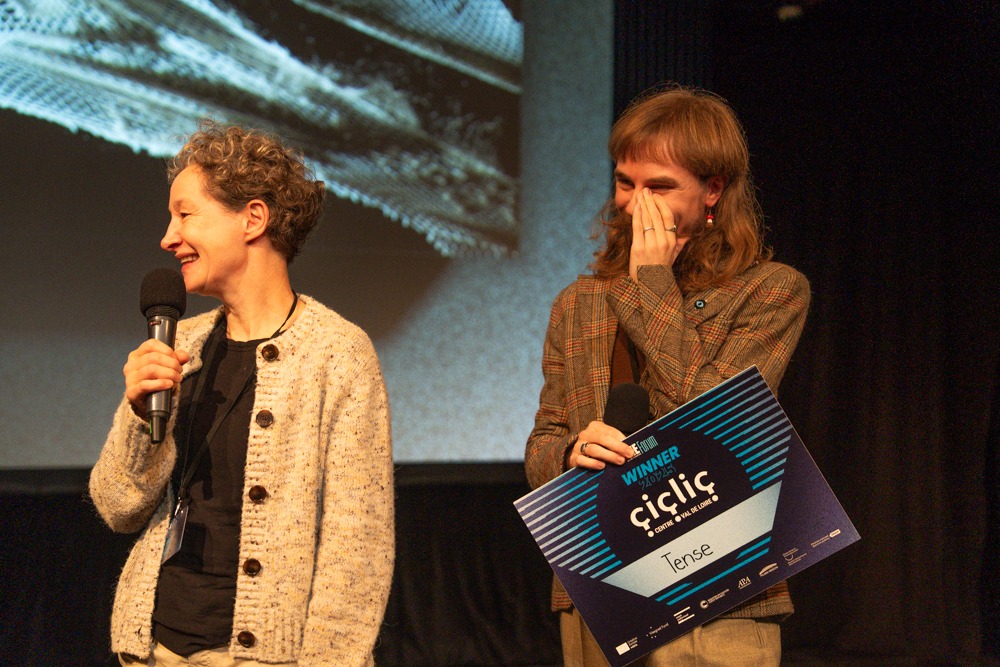
Reginaud: In 2025, we presented this award for the fourth time. In the past, the prize went to FUNFAIR (Éva Darabos, Hungary; 2022), NIGHTBLOOM (Kata Gugić, Croatia; 2023), ANT (Jonatan Schwenk, Germany; 2024), and from the latest edition, we invited TENSE by Konrad Hjemli (Norway).
What does a film need to be chosen for a CICLIC residence?
Reginaud: What interests me is discovering projects I wouldn’t necessarily meet elsewhere. Submitting a film to a committee or jury that has to reach a unanimous decision is always difficult. With more unusual projects, such as experimental or non-narrative films, it can be especially hard to convince an entire committee. My choice is a personal one. I don’t focus on how much a project might appeal to our selection committee, but rather on how much it could benefit from CICLIC’s financial and logistical support. At the same time, filmmakers have to be able to work within the conditions of our residency, because this kind of programme is not for everyone. It’s not suited to people who see every step of filmmaking as a collective process, nor to those who lead a regular life with an additional job. There are many parameters to consider, and the choice I make is not a compromise — not for me, and not for them.
What are your general impressions about the projects presented at the Forum?
Reginaud: I am always impressed by the wide variety of projects, ranging from classic stories to diverse narrative forms that experiment with genre conventions. The Forum is my place to discover projects from Eastern Europe, but also Western and Northern Europe are represented. What I particularly appreciate is the event’s accessibility. It’s a well-organised, pleasant experience; the size is human-scale, and it’s easy to connect with others. At large events, you spend a lot of time missing people; here, it’s impossible to miss anyone.
The event also testifies to the development of animation in Central Europe, where people have cast off the shadow of the past and now stand firmly on their own two feet.
Reginaud: Each country brings its own culture and its own approach to coproduction, and CEEA helps everyone work together, fulfilling its role as a networking hub. Here, you can observe the alchemy between people and find affinities. This method is what truly helps projects move forward and injects new life into collaborations.
There seems to be a strong connection between France and Central Europe. Many recent animated features, such as LIVING LARGE, TALES FROM THE MAGIC GARDEN, and EVEN MICE BELONG IN HEAVEN, had a French partner on board.
Reginaud: Stop-motion animation has many fans in France, who want to see this tradition continued. Many studios are not exactly specialised in this technique, but cherish a love for the genre: Vivement Lundi!, JPL Films, XBO Films, Foliascope, etc. Anyone who wants to develop a stop-motion project does so by definition as a co-production, for which you can accumulate funding from several countries. And when you say co-production, you say Central Europe, with countries such as the Czech Republic and Poland, where they do have the know-how and where budgets are interesting.
These are perfect reasons for France to co-produce with Central Europe. And what would be the reasons for Central European countries to co-produce with France?
Reginaud: My three main reasons would be: our know-how, our solid production companies, and our funding system. And then there is the shared appeal that stop-motion has in both partner countries.
Do French animation schools further fuel this love?
Reginaud: Not at all. There is no school specialising in stop-motion in France (even though there is a professional training in Brittany). Interest was sparked more by foreign titles and some French co-productions. The success of Aardman certainly set something in motion, and then there were films such as THE NIGHTMARE BEFORE CHRISTMAS, CORALINE, and MY LIFE AS A ZUCCHINI. Since we started the residency 25 years ago, we sensed a strong desire among certain producers, such as Vivement Lundi! and JPL Films, to work with the genre. The residency’s origin lies entirely there; initially, we worked only with stop-motion shorts because we felt this genre needed a dedicated production space. Many animation techniques can be mastered at home with a computer, but not stop-motion! You need a special space and facilities for that, and this is what we offer.
You primarily reduce CICLIC to the residency, but there is much more to it!
Reginaud: CICLIC offers numerous options. Our primary support is in producing animated shorts, but we also offer script and development support for features, TV projects, and series. We have a scholarship for graduating students from the École de la Poudrière in Valence, who are invited to the residence to work on script and development, sometimes with input from regional producers. We have had residential partnerships with international structures, such as the Tshimologong Digital Innovation Precinct for sub-Saharan Africa and the Mexican Festival Pixelatl for Latin America, and this year, together with CNC, the French Embassy in Iran, and NEF Animation, we launched a partnership with Iran.
CICLIC was born out of numerous ambitions, which were not all in animation.
Reginaud: We work along several axes: one focuses on the audiovisual, another on books. That’s why we offer both visual education and writing training. We’re also involved in promotion and production funding for cinema and literature, collaborating with publishers, libraries, and other partners. But our core focus is always on writing and developîng, and on the emergence of new talents and formats. In addition, we curate an archive of amateur films from our region, created by citizens around topics relevant to our community. These films are collected, restored, digitised, and screened in thematic compilations.
You mention production, promotion, archiving,… Is distribution the only link in the production chain that you are not involved in?
Reginaud: Yes, we are! Through the Diffusion service, we promote the distribution of films that we have supported. In addition, we try to offer cinema to remote areas of the region where people rarely have access to theatres. We have three cinémobiles: trucks on which a cinema room was mounted. They drive to the small villages probably once a month, and depending on what has been agreed with the local authorities, two, three, or four screenings will be organised. The cinema rooms have around 80 seats and are well-equipped with DCP projection. The truck driver is also the projectionist and the cashier.
Have you ever thought about expanding this model nationwide? There must be a huge market for it.
Reginaud: CICLIC’s goal is to work locally, in Centre-Val de Loire, and not at a national level. But one of the trucks can be rented for events and festivals. Above all, we want our own films to reach an audience, so at CICLIC Animation, we have a small cinema (48 seats) where we regularly organise screenings for the people of Vendôme, so that they can stay in touch with what is happening in the residence.
Gert Hermans
Cover artwork: © Spata


